Every product a company brings to market carries an implicit promise: it will work reliably for as long as customers expect it to. Proving that promise before a product ships, without waiting years to watch it fail in the field, is the central challenge that Accelerated Life Testing (ALT) solves. At Relteck, our accelerated life testing services help engineering, quality, and reliability teams compress years of real-world wear into weeks of controlled laboratory stress, giving product teams the statistical confidence they need to launch on schedule without gambling on long-term durability.
Accelerated Life Testing is a reliability engineering discipline that intentionally exposes products, components, or materials to stress levels higher than what they will experience in normal use. By applying elevated temperature, humidity, voltage, vibration, or cyclic loading, ALT triggers the same failure mechanisms that would otherwise take months or years to appear, but in a fraction of the time. Engineers then use well-established statistical models to translate the accelerated failure data back into a realistic prediction of how the product will perform under normal, everyday conditions.
What Is ALT Methodology?
The foundation of any accelerated life testing program is a defensible methodology that connects laboratory stress to field reality. Relteck’s ALT methodology follows a structured, repeatable sequence:
- Define the failure mode of interest: Identify the specific degradation mechanism under study, such as solder joint fatigue, insulation breakdown, corrosion, or seal wear-out.
- Select the acceleration variable: Choose the stressor (temperature, voltage, humidity, cycling rate) that is physically linked to the failure mechanism and can be scaled safely without introducing new, unrealistic failure modes.
- Determine stress levels: Set multiple elevated stress levels above normal operating conditions so that a dose-response relationship can be established between stress and time-to-failure.
- Run the test and collect time-to-failure data: Monitor units continuously or at fixed intervals until failure, using censored data methods for units that survive the full test duration.
- Fit a statistical life-stress model: Apply the appropriate mathematical model to translate accelerated results into a life prediction at normal use conditions.
- Validate and report: Cross-check model predictions against historical field data or pilot samples, then document confidence intervals and assumptions for engineering and regulatory review.
This structured approach ensures that every prediction Relteck delivers is traceable, repeatable, and defensible in front of customers, auditors, or certification bodies.
Statistical Models Used in ALT
Turning accelerated stress data into a meaningful life prediction requires the right statistical model. Relteck’s reliability engineers select from several proven models depending on the product, the failure mechanism, and the type of stress applied.
Arrhenius Model
The Arrhenius model is the workhorse of thermally driven reliability testing. Originally developed to describe chemical reaction rates, it captures how failure mechanisms such as insulation degradation, adhesive breakdown, or electromigration accelerate as temperature rises. By running units at several elevated temperatures and measuring time-to-failure at each, Relteck engineers calculate an activation energy for the failure mechanism and use it to extrapolate the expected life at normal operating temperature. This model is especially valuable for electronic components, batteries, adhesives, and polymers whose degradation is chemically driven.
Weibull Distribution
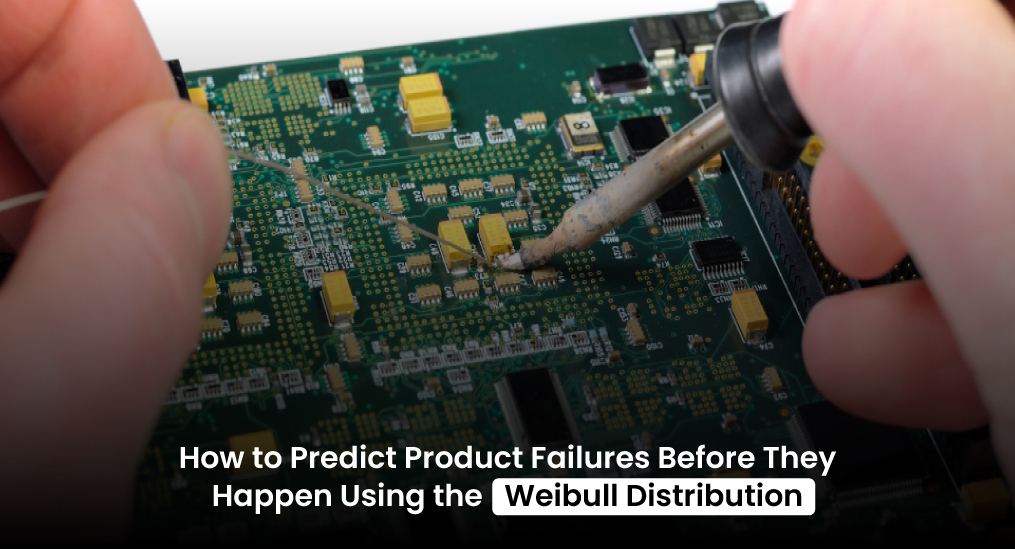
Where the Arrhenius model explains how stress accelerates failure, the Weibull distribution describes how failures are distributed over time within a population of units. Its flexible shape parameter can represent early-life infant mortality, random failures, or wear-out behavior, making it the most widely used distribution in reliability engineering. Relteck applies Weibull analysis to accelerated test data to estimate the characteristic life (eta) and shape parameter (beta) of a product, which then feed into B10 life calculations, warranty modeling, and spare-parts planning.
Eyring Model
The Eyring model extends the Arrhenius approach to situations involving more than one stress factor, such as combined temperature and humidity or temperature and voltage. It is grounded in chemical reaction rate theory and is particularly useful for failure mechanisms sensitive to moisture ingress, corrosion, or electrochemical migration. Relteck uses the Eyring model when a single-stress model cannot fully explain the degradation behavior observed in multi-stress environments such as humid, high-voltage electronics or automotive underhood components.
In many programs, Relteck combines these models, for example a Weibull distribution for the underlying failure-time behavior paired with an Arrhenius or Eyring acceleration factor, to build a complete life-stress relationship that engineering and business stakeholders can rely on.
Stress Factors Applied in Accelerated Life Testing
Choosing the right stress factors, and applying them at the right levels, is what separates a meaningful ALT program from a test that simply breaks products in unrealistic ways. Relteck’s test engineers design stress profiles around the actual failure mechanisms a product is likely to encounter in the field.
- Temperature: Elevated and cycled temperatures accelerate chemical reactions, thermal expansion mismatches, solder fatigue, and material aging. High-temperature operating life (HTOL) and temperature cycling tests are among the most common ALT protocols.
- Humidity: Combined temperature-humidity testing accelerates moisture absorption, corrosion, and electrochemical migration, which is critical for connectors, PCBs, coatings, and outdoor or automotive products.
- Voltage: Overvoltage and voltage-cycling stress accelerate dielectric breakdown, capacitor wear-out, and semiconductor degradation, helping teams validate power electronics, capacitors, and insulation systems.
- Vibration and mechanical loading: Where relevant, Reltecklayers in vibration, shock, or cyclic mechanical loading to capture fatigue-driven failure modes alongside environmental stressors.
By combining these stressors in controlled chambers with continuous monitoring, Relteck generates the time-to-failure datasets that make Arrhenius, Weibull, and Eyring modeling statistically meaningful rather than speculative.
How ALT Shortens Time-to-Market Decisions
Product launch timelines rarely leave room for years of passive field observation, yet stakeholders still need confidence that a new design will survive its warranty period. Accelerated life testing closes that gap directly:
- Faster go/no-go decisions: Instead of waiting for field returns, design teams get statistically grounded life predictions within weeks, enabling data-driven launch decisions.
- Early design flaw detection: Because ALT deliberately accelerates weak points, it surfaces marginal components, poor solder joints, or under-rated materials long before they become expensive field failures.
- Warranty and reliability targeting: Weibull-based B10 or B50 life estimates let product management set warranty periods and reliability specifications with quantified confidence rather than guesswork.
- Supplier and component qualification: ALT allows engineering teams to compare candidate components or vendors on a like-for-like reliability basis before committing to a bill of materials.
- Reduced field failure costs: Catching wear-out and degradation mechanisms in the lab avoids the far larger cost of recalls, warranty claims, and brand damage after launch.
Because Relteck structures every ALT program around clear pass/fail criteria and statistically defensible life predictions, engineering, quality, and executive stakeholders can align on a single dataset instead of debating anecdotal impressions of reliability. That shared confidence is what ultimately shortens the path from prototype to shipped product.
Why Choose Relteck for Accelerated Life Testing Services
Relteck combines environmental chambers, precision monitoring instrumentation, and experienced reliability statisticians to design ALT programs tailored to your product’s real operating environment, not a generic test template. From initial failure-mode analysis through Arrhenius, Weibull, and Eyring modeling to final reporting, our team works alongside your engineering group to turn accelerated stress data into decisions you can defend to customers, regulators, and leadership.